
To Manage or To Lead
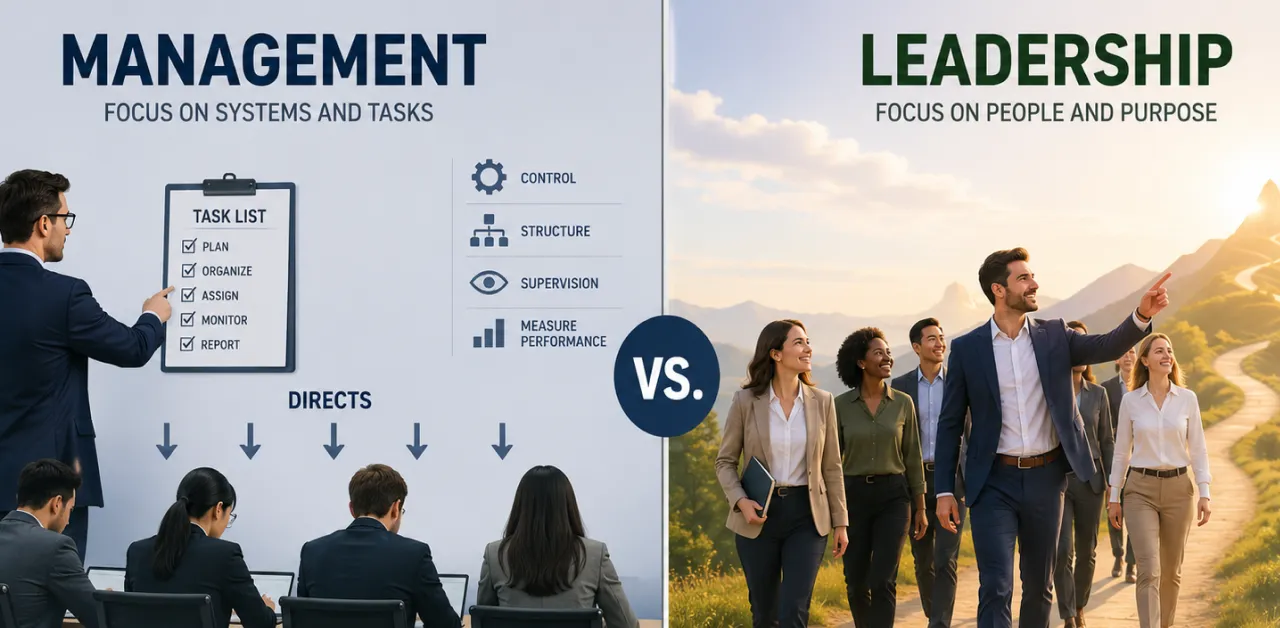
If you have ever attended a management or leadership course, you may have heard of the acronym POLC; a concept many of us had drilled into us as students: Plan, Organise, Lead and Control.
What lecturers often neglect to explain is that we need to lead people and control resources, not the other way around.
Working in a large corporate organisation often means volunteering for one of the many health and safety roles required on each floor. These roles usually come with additional duties, such as assisting with mandatory evacuation drills, completing health and safety reports, maintaining the first aid kit, or attending intensive first aid courses – which included the feared practical examination.
One year, while the Occupational Health and Safety Representative, I was instructed to ensure that employees did not eat lunch at their desks, but rather used the designated eating areas.
On a regular basis, I would ask my fellow employees to eat in the canteen rather than at their desks. My messages, however, fell on deaf ears. Many of my colleagues refused to listen.
“You are not my manager. Why must I listen to you?” Echoed each time I asked.
That response stayed with me. I realised that I was being directive and trying to control their behaviour, an almost impossible mission. I was enforcing a rule without helping them understand the reason behind it. At that moment, I was managing compliance rather than leading people. My approach was not working. Instead, I needed to lead them. After repeatedly failing to get my colleagues to eat in the designated eating areas, I changed my tactic.
I gathered the employees one afternoon and started with a simple question:
“Who likes cockroaches?” There was a resounding “Noooo!” from all and sundry.
“Cockroaches love the crumbs and small food particles left behind on the carpet after you eat breakfast, tea, or lunch at your desk.”
Suddenly, my colleagues took note of the message. The more I tried to control them, the less responsive they became. As soon as my message focused on a clear reason, there was less control and more leadership. The next day, all the employees were using the tables in the canteen. Problem solved.
Control may get compliance, yet leadership creates commitment.
Here are a few practical ways leaders can lead better:
1. Explain the purpose, not only the task
Instead of saying, “Do this report by Friday,” say:
“This report helps us understand where the team is winning, where we are stuck, and what decisions we need to make by Friday.”
People take more ownership when they know why the work matters.
2. Set clear outcomes, then give room for judgement
Control says, “Do it exactly like this.” also known as my way or the highway. Leadership says, “This is the result we need. Here are the standards. How do you think we should approach it?”
This gives structure without removing responsibility.
3. Ask more questions before giving answers
A controlling manager gives quick instructions.
A leader asks:
“What do you think is the best next step?”
“What support do you need?”
“What risks should we consider?”
“What would success look like?”
Questions build thinking, while instructions often create dependency.
4. Replace micromanagement with check-in points
Instead of watching every move, agree on milestones:
“Let’s check progress on Wednesday morning, and if anything blocks you before then, let me know early.”
This gives people space while still keeping them accountable.
5. Trust people before they are perfect
Leadership does not mean leaving people alone completely. It means trusting them enough to grow. A helpful phrase is:
“I trust you with this. I am available if you need guidance, but I want you to take the lead.”
Whether you are trying to eradicate cockroaches in your building or improve performance in your team, lead and inspire rather than control and demand.
Leaders create clarity, trust, accountability, and purpose. Control makes people wait for instructions. Leadership helps people think, decide, act, and grow. We certainly need more of the latter.
Want to learn how to lead people rather than control them?
Paul Tanton
Leadership Entrepreneur and Coach